Pacemaker Treatment in Indore is a safe and effective option for a heart that beats too slowly. Dr. Shirish Agrawal, a trusted Cardiologist in Indore, helps patients understand when a pacemaker is truly needed and when other treatment may work better.
A heart that beats too slowly or unevenly can make you feel dizzy, tired or faint. This guide explains when a patient needs a pacemaker, how the procedure works and what recovery looks like. It will also help you know when to see a Cardiologist in Indore.
Whether your doctor has already advised Pacemaker Treatment in Indore or you are only exploring your options, this article will help you ask the right questions. It is for education only. Every heart is different, and only a qualified Heart Specialist in Indore can decide whether you need a pacemaker.
What Is a Pacemaker?
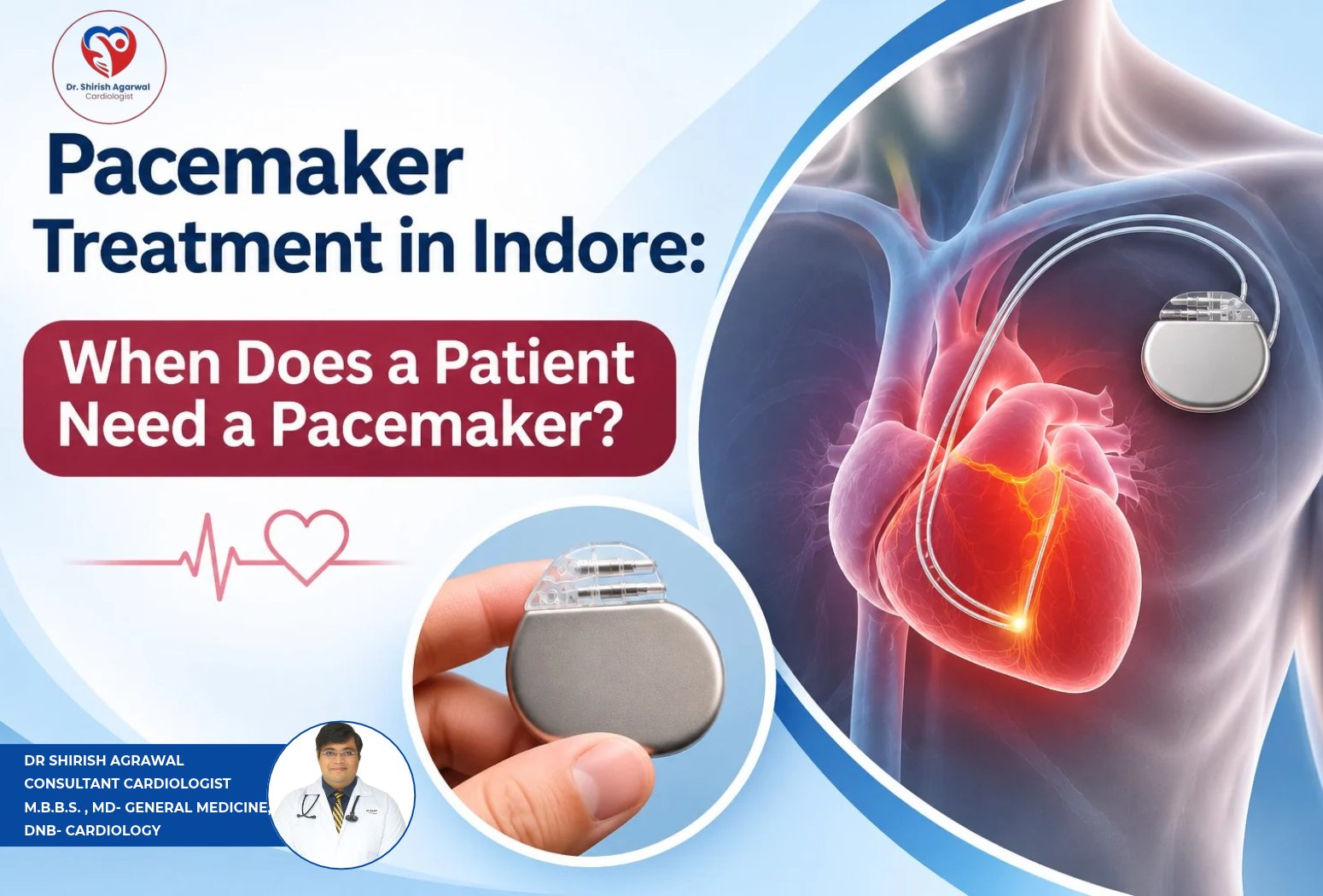
A pacemaker is a small, battery-powered device placed under the skin of the chest. It watches your heart rhythm all day and night. When the heartbeat becomes too slow or pauses, it sends a tiny electrical signal that makes the heart beat on time.
A pacemaker has two main parts:
- Pulse generator: a small metal case that holds the battery and the electronic circuit.
- Leads: thin, insulated wires that carry signals between the heart and the generator.
You will not feel these signals. Modern devices work only when your heart needs help, so they do not take over your heartbeat.
How the Heart’s Electrical System Works
The heart has a natural “spark plug” called the sinus node. It sits in the upper right chamber and sends an electrical signal with every beat. The signal travels to the lower chambers through a relay point called the AV node, and the heart squeezes to pump blood.
If the sinus node fires too slowly, or the signal gets blocked on the way, the heart rate drops. The brain and body then receive less blood than they need. A pacemaker is designed to fix this problem.
When Does a Patient Need Pacemaker Treatment in Indore?
A patient needs a pacemaker when the heart beats too slowly or pauses, and this causes symptoms or puts health at risk. A slow heartbeat is called bradycardia. Not every slow pulse needs treatment, and some healthy, athletic people naturally have low heart rates.
A Heart Specialist in Indore usually considers Pacemaker Treatment in Indore in the following situations.
- Sick Sinus Syndrome
In this condition, the heart’s natural pacemaker does not work properly. The heart may beat too slowly, pause, or switch between slow and fast rhythms. It becomes more common with age. - Heart Block (AV Block)
In heart block, the electrical signal is delayed or blocked between the upper and lower chambers. There are three degrees:
- First-degree block: the signal is slow but still gets through. It usually needs no treatment.
- Second-degree block: some signals do not get through. Certain types need a pacemaker.
- Third-degree (complete) block: no signals pass through. This is serious and usually needs a pacemaker.
- Slow Heart Rate With Atrial Fibrillation
Some people with atrial fibrillation (an irregular rhythm) also have long pauses or a very slow rate. This can happen on its own or because of the medicines used to control the rhythm. A pacemaker protects against the slow phases. - Repeated Fainting Linked to Heart Rhythm
Sometimes tests show that fainting (syncope) is caused by a slow heartbeat or long pauses. A pacemaker can prevent further episodes and lower the risk of falls and injuries. - Certain Types of Heart Failure
Some patients with weak heart muscle have a delay between the left and right sides of the heart. A special pacemaker, called cardiac resynchronisation therapy (CRT), helps both sides pump together.
Symptoms That Should Not Be Ignored
A slow heartbeat often starts with mild symptoms that people blame on age or stress. Please meet a Cardiologist in Indore if you notice any of these:
- Dizziness or light-headedness
- Fainting or near-fainting episodes
- Unusual tiredness or weakness
- Shortness of breath on light activity
- Chest discomfort
- Confusion or trouble concentrating
- A very slow or uneven pulse
- Reduced ability to walk or exercise as before
Seek emergency care immediately if you faint suddenly, have severe chest pain or have trouble breathing.
Why Early Evaluation Matters
Waiting too long can be risky. A very slow heartbeat can lead to falls, injuries and worsening heart weakness. In severe cases, it can become life-threatening. Early assessment with a Heart Specialist in Indore helps find the cause and plan treatment calmly instead of in an emergency.
Many families from Bhopal, Ujjain and Dewas travel to Indore for advanced cardiac care, because the city has well-equipped cardiac centres. If you are coming from Bhopal, carry your earlier ECGs, reports and prescriptions to save time at the first visit.
Tests Before Pacemaker Treatment in Indore
Your doctor will not decide based on symptoms alone. You may be asked to undergo some of these tests:
- ECG (electrocardiogram): records the heart’s electrical activity in a few minutes.
- Holter monitor: a portable device worn for 24 to 48 hours to catch rhythm problems that come and go.
- Event or loop recorder: used when symptoms are rare and need longer monitoring.
- Echocardiogram: an ultrasound scan that shows the heart’s structure and pumping strength.
- Treadmill test: checks how the heart rate responds to exercise.
- Blood tests: look for causes such as thyroid problems or electrolyte imbalance.
- Electrophysiology (EP) study: a specialised test in selected patients to study the heart’s electrical pathways.
Your Cardiologist in Indore will also review your medicines. Some blood pressure and heart rhythm tablets can slow the heart. Adjusting them may sometimes solve the problem, and a pacemaker is advised only when it is truly needed.
Types of Pacemakers
Your cardiologist chooses the device that matches your heart condition.
| Type | How it works | Who may need it |
| Single-chamber | One lead in one heart chamber | Patients needing support in one chamber |
| Dual-chamber | Two leads in two chambers | Many patients with heart block or sick sinus syndrome |
| Biventricular (CRT) | Three leads to coordinate both sides | Selected heart failure patients |
| Leadless | Tiny capsule placed inside the heart | Selected patients, depending on suitability |
Many devices adjust to your activity. They speed up when you climb stairs and slow down when you rest.
What to Expect During Pacemaker Treatment in Indore
Many people worry about the word “surgery.” Pacemaker implantation is a minor procedure compared with open-heart surgery. It does not involve opening the chest.
Before the Procedure
- You will be asked to avoid food and drink for several hours.
- Your doctor will tell you which medicines to continue or pause.
- Blood tests and a heart scan are usually reviewed beforehand.
- You will sign a consent form after the doctor explains the benefits and risks.
During the Procedure
- The chest area near the collarbone is cleaned and numbed with local anaesthesia. You usually stay awake but comfortable, and mild sedation may be given.
- The doctor makes a small cut below the collarbone.
- The leads are guided through a vein into the heart with live X-ray imaging.
- The leads are tested and fixed in position.
- The pulse generator is connected and placed in a small pocket under the skin.
- The cut is closed with stitches or surgical glue.
The procedure often takes one to two hours, though timing varies.
After the Procedure
Most patients stay in hospital for a day or two for observation. A chest X-ray and a device check are done before discharge. You will receive a pacemaker ID card, which you should carry at all times.
Recovery After Pacemaker Treatment in Indore
Most people recover well and return to normal daily life within a few weeks. Your doctor will give personal instructions, but general advice includes:
- Keep the wound clean and dry as advised.
- Avoid lifting heavy objects for the period your doctor suggests.
- Avoid raising the arm on the implant side above shoulder level for the first few weeks, so the leads can settle.
- Do not press or rub the area over the device.
- Take medicines exactly as prescribed.
- Attend all follow-up visits.
Warning Signs After Implantation
Call your doctor promptly if you notice:
- Redness, swelling, pus or increasing pain at the wound
- Fever
- Dizziness or fainting that returns
- Continuous hiccups or muscle twitching in the chest or belly
- Swelling of the arm on the device side
Risks and Complications
Pacemaker implantation is considered safe and is performed very commonly worldwide. Like any procedure, it carries some risks:
- Infection at the device site
- Bleeding or bruising
- A collapsed lung (rare)
- Lead movement from its position
- Reaction to medicines or anaesthesia
Experienced teams use sterile techniques and careful monitoring to keep these risks low. Your Cardiologist in Indore will explain them before the procedure, based on your health.
Living With a Pacemaker: Everyday Questions
Life with a pacemaker is usually active and comfortable. Here are some practical points:
- Mobile phones: use the phone on the ear opposite the device, and avoid keeping it in a pocket directly over the pacemaker.
- Household appliances: microwave ovens, TVs and kitchen appliances are generally safe.
- Security checks: show your ID card at airports and avoid lingering near metal detectors.
- MRI scans: many newer pacemakers are MRI-conditional, but always inform the doctor before any scan.
- Exercise and travel: most people can walk, travel and do light exercise. Ask your doctor about sports and strenuous activity.
- Battery life: batteries often last around 7 to 12 years or more, depending on the device and use. Replacing the generator is usually simpler than the first implantation.
Regular Follow-Up Is a Must
A pacemaker is not a “fit and forget” device. Checks are usually done within the first weeks and then every six to twelve months, or as your doctor advises. The doctor reads the device with a small programmer to look at battery status, lead function and rhythm records. Settings can be adjusted without needles or pain.
Because care continues for years, easy access matters. If you live in or near Vijay Nagar, choosing a Heart Specialist in Indore whose clinic is close to home can make regular checks more convenient.
How to Choose the Best Cardiologist in Indore
Searching online shows many options, so these points can help you find the Best Cardiologist in Indore for your needs:
- Training and qualifications: check the doctor’s registered degrees and cardiology training.
- Experience: ask how often the doctor handles rhythm problems and device implantation.
- Hospital facilities: a well-equipped cath lab, ICU and emergency support are essential.
- Clear communication: a good doctor explains options in simple words.
- Follow-up care: device care lasts for years, so easy access to your doctor matters.
- Honest advice: the right Cardiologist in Indore tells you when a pacemaker is not needed, as well as when it is.
Why Professional Experience Matters
Heart rhythm problems can look similar, but their causes and treatments differ widely. Experience helps a doctor read test results accurately, pick the right device and place leads safely. It also helps in handling rare complications.
When you meet Dr. Shirish Agrawal or any other Heart Specialist in Indore, ask how often they manage rhythm problems and device follow-up. A confident, clear answer is a good sign.
Complete Heart Care Beyond Pacemakers
Rhythm problems often exist alongside other conditions. A Heart Specialist in Indore looks at the full picture, including blood pressure, blocked arteries, heart valves and heart muscle strength.
Comprehensive care may include medicines, lifestyle guidance, diagnostic tests and, when needed, procedures. Patients benefit from a doctor who looks at the whole heart, not only one test result. You can discuss all these concerns openly with Dr. Shirish Agrawal.
When to Seek Professional Help
Do not wait for symptoms to become severe. Book an appointment with a Cardiologist in Indore if:
- You have fainted or nearly fainted without a clear reason
- Your pulse is often below 50 beats per minute and you feel unwell
- You feel breathless or very tired with routine activity
- A family member has a history of rhythm problems or sudden cardiac events
- You have been told you have “heart block” or a “slow heart rate” and have had no follow-up
If your doctor has already advised a pacemaker, do not postpone the next step. Patients from Bhopal and nearby towns can also book a consultation with Dr. Shirish Agrawal after sharing their reports in advance. Early action protects your heart.
Heart-Healthy Habits
Not every rhythm problem can be prevented, but a healthy lifestyle supports any treatment you receive:
- Eat a balanced diet with vegetables, fruits and whole grains
- Reduce salt, sugar and deep-fried foods
- Stay physically active, with your doctor’s approval
- Avoid smoking and tobacco
- Limit alcohol
- Control blood pressure, diabetes and cholesterol
- Sleep well and manage stress
- Take medicines regularly and never stop them on your own
Frequently Asked Questions (FAQs)
- When does a patient need a pacemaker, and when should I see a Cardiologist in Indore?
A patient needs a pacemaker when the heart beats too slowly or pauses and this causes symptoms such as fainting, dizziness or breathlessness. Common reasons are sick sinus syndrome and heart block. See a Cardiologist in Indore as soon as you notice these signs, because an ECG and a few other tests can confirm the need. - What is Pacemaker Treatment in Indore, and is it safe?
Pacemaker Treatment in Indore is a minor procedure in which a small device is placed under the chest skin, with wires guided into the heart. It is considered safe and is done under local anaesthesia in most cases. Your Heart Specialist in Indore will explain the small risks beforehand. - What are the early signs that I should visit a Heart Specialist in Indore?
Fainting, repeated dizziness, unusual tiredness, a slow pulse and shortness of breath are the main warning signs. If you notice them, a Heart Specialist in Indore can arrange an ECG and a proper check-up without delay. - How long does Pacemaker Treatment in Indore take?
The procedure usually takes about one to two hours, though it varies from patient to patient. Most people stay in hospital for a day or two, so the team can watch the device and the wound. - Is Pacemaker Treatment in Indore painful?
It is done under local anaesthesia, so you should not feel pain during the procedure. Mild soreness around the wound is common for a few days and can be managed with medicines your doctor prescribes. - How long does a pacemaker battery last, according to a Heart Specialist in Indore?
A Heart Specialist in Indore will tell you that the battery commonly lasts around 7 to 12 years or more, depending on the device and how often it works. Regular checks show how much battery is left, and replacing the generator is usually a shorter procedure. - Can I live a normal life after Pacemaker Treatment in Indore?
Yes. Most patients return to daily activities, light exercise, travel and work within a few weeks. Regular follow-up with a trusted Cardiologist in Indore keeps the device working well. - Can medicines help avoid the need for a pacemaker?
It depends on the cause. If medicines are slowing the heart, changing them may help. When the heart’s electrical system itself is damaged, medicines usually cannot fix it, and a pacemaker is the safest option. A Cardiologist in Indore can tell you which applies to you. - Can patients from Bhopal get Pacemaker Treatment in Indore?
Yes. Many patients from Bhopal travel to Indore for rhythm checks and pacemaker care. Carry your old reports and ECGs, so the team has the full history. - How do I find the Best Cardiologist in Indore?
Look for recognised qualifications, relevant experience, access to proper hospital facilities and clear communication. Also check how easy follow-up will be, since pacemaker care continues for years. - Can I use a mobile phone or microwave after Pacemaker Treatment in Indore?
Yes, in normal use. Keep the phone on the opposite ear and avoid carrying it in the pocket over the device. Your Heart Specialist in Indore will give any extra precautions for your device. - Who should I consult if I suspect a rhythm problem?
Start with a qualified cardiologist. You can consult Dr. Shirish Agrawal, cardiologist, for an assessment of your symptoms and a clear plan, including whether Pacemaker Treatment in Indore is needed.
Conclusion
A pacemaker is a simple but life-changing device for people whose hearts beat too slowly or unevenly. If you have repeated fainting, dizziness or unexplained tiredness, do not ignore these signs. Early testing, a correct diagnosis and timely care can protect your health.
If Pacemaker Treatment in Indore has been advised, take time to understand the reason, the type of device and the follow-up plan. Knowing what to expect will help you feel calmer and more prepared. For expert guidance, book a consultation with Dr. Shirish Agrawal, a Cardiologist in Indore and Heart Specialist in Indore for rhythm problems and everyday heart care.